Most Visited Articles
Current Issue: Volume 8, Issue 15, August 2026
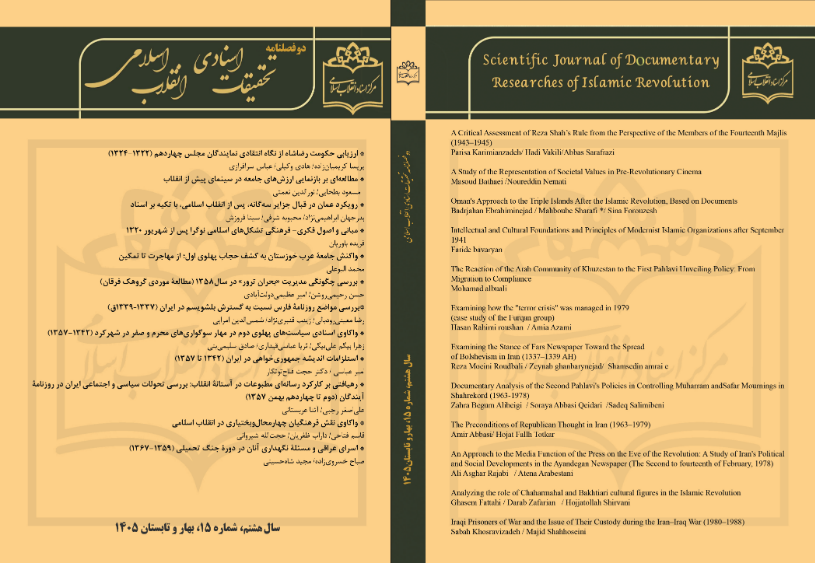
Evaluation of Reza Shah's government from the critical perspective of the representatives of the Fourteenth Parliament (1322-1324 AH)
Pages 5-40
Parisa Karimiyanzadeh, Hadi Vakili, Abbas Sarafrazi
A Study on the Representation of Societal Values in Pre-Revolutionary Cinema
Pages 41-72
Nooraldin Nemati, Massoud Bathaee
Oman's Approach to the Triple Islands After the Islamic Revolution, Based on Documents
Pages 73-109
Badrjahan Ebrahiminejad, Mahboube Sharafi, Sina Forouzesh
Intellectual-Cultural Foundations and Principles of Modern Islamic Organizations after September 1941 Organization
Pages 111-165
Farideh Bavarian
The Reaction of the Arab Community of Khuzestan to the First Pahlavi Unveiling Policy: From Migration to Compliance
Pages 167-198
Mohammad Albuali
Examining how the "terror crisis" was managed in 1979 (case study of the Furqan group)
Pages 199-248
Hasan Rahimi (roushan), Amir Azimidolatabadi
Examining the Position of Fars Newspaper Toward the Spread of Bolshevism in Iran (1337–1339 AH)
Pages 249-281
Reza Moiniroudbali, Zeinab Ghanbarinejad, Shamsedin Amraei
Documentary Analysis of the Second Pahlavi's Policies in Controlling Muharram and Safar Mournings in Shahrekord (1342-1357)
Pages 283-315
Zahra Beigumalibeigi, Soraya Abbasigheidari, Sadegh Salimibani
The Implications of Republican Thought in Iran (1963 to 1978)
Pages 317-346
Amir Abbasi, Hojjat Fallahtootkar
An Approach to the Media Function of the Press on the Eve of the Revolution: A Study of Iran's Political and Social Developments in the Newspaper Ayandegan (Second to fourteenth February 1978)
Pages 347-375
Atena Arabestani, Aliasghar Rajabi
An Analysis of the Role of Educators in Chaharmahal and Bakhtiari during the Islamic Revolution
Pages 377-414
Ghasem Fattahi, Darab Zafarian, Hojaatallah Shirvani
Iraqi prisoners and the issue of their detention during the imposed war (1359-1367)
Pages 415-440
Sabah Khosravizadeh, Majid Shahhoseini
Publication Information
Director-in-Charge
Editor-in-Chief
Editorial Board
International Editorial Board
Advisory Board
Past Editorial Board
Associate Editor
Senior Editor
Frequency
Semiannual
Print ISSN
Online ISSN
Search
Indexing and Abstracting





Keywords Cloud
- Islamic Revolution
- Pahlavi II
- Iran
- Second Pahlavi
- Imam Khomeini
- imposed war
- Mohammad Reza Shah
- America
- Pahlavi
- Foreign Policy
- Ayatollah Khamenei
- Pahlavi Era
- Iraq
- World War II
- Reza Shah
- clerics
- SAVAK
- Islamic Revolution of Iran
- Women
- Britain
- Islamic Republic of Iran
- Mohammad Reza Pahlavi
- elections
- Security
- Students
- political notes
- Diffusion Theory
- Bushehr
- Mazandaran
- Pahlavi regime
- Correspondence
- Kermanshah
- Discourse
- Iranian Chancery Documents
- Keywords: Iran
- Tourism
- Iran-Iraq war
- crisis management
- colonialism
- Crisis
- Rural development
- Defense
- First Pahlavi
- Isfahan
- Hashemi Rafsanjani
- Mohammad Reza Shah Pahlavi
- Documents
- Text-based approach
- Teachers
- content analysis
- Democracy
- Shahrekord
- student movement
- National Assembly
- Islamic movement
- Exile
- Shiites
- Chaharmahal and Bakhtiari
- Military Power
- Foreign Relations
- peasants
- National Assembly representatives
- Documentary Elements Standard
- Lifestyle
- political participation
- Document Analysis Methodology
- Iranian Historical Documents
- Revolution
- culture
- clergy
- Tudeh Party
- Soviet Union
- Communism
- Larestan
- Ayatollah Malek Hosseini
- Fiction
- land reform
- Representation of Identity
- social practice
- political struggle
- Ideology
- historical explanation
- Seyyed Hossein Alam El-hoda
- the 40th anniversary of the martyrs
- National Identity Components
- scenario building
- Defense Cooperation
- communication model
- Keywords: Islamic Revolution
- Europe
- Indonesia
- Islamic Coalition Delegations
- cultural elements
- Theme analysis
- Tobacco monopoly
- Revolutionary Council
- Iranian and American Association
- advertisement
- Media
- social reactions
- Revolutionism
- Homafars
- Sari
- Islamic Culture
- Gendarmerie
- International Monetary Fund
- reformism
- Film Farsi
- Saudi Arabia
- sit-in
- popular view
- First Pahlavi state
- Israeli regime
- Keywords: Islam
- Esfahan Steel Company
- activity of separatist groups
- Washington Consensus
- Local history
- Islamic world
- Muharram
- Natanz
- Cold War
- economic policies
- Structural Functionalism
- political system
- Abraham Accords
- verses of war and jihad
- Social Life
- assassination
- theme
- peaceful struggle
- People
- Patriarchy
- Islamism
- Western lifestyle
- Islamic Unity
- Resistance
- World War
- merchants
- 1953 coup
- Neil Smelsar
- Army
- hallyday
- Marxism
- Historiography
- Torbat-e Heydarieh
- Kermanshah province
- : power behind discourse
- Alam family
- category
- Islamic Civilization
- Resistance Front
- Near East Foundation
- The Supreme Leader
- comprador bourgeoisie
- Pahlavi period
- Representatives
- Hoggett Strand\'s diffusion theory
- rightism and conservatism
- Arab community of Khuzestan
- Obstacles
- coordination and harmony
- Revolutionary Decade
- Clergy Front
- Air Force
- Agents
- United Arab Emirates
- Democratic Party of Azerbaijan
- \"؛ Ayatollah Khamenei\"
- Howeizah
- Ethnic Gap
- political factionalism
- National Development
- . Lyndon Johnson
- Banning hijab
- Keywords: National Identity
- contemporary Iran
- revolutionary sentiment
- Pahlavi state
- Kheibar Goudarzian
- Hassan Rouhani
- Ulama of Khorasan
- neoliberalism
- Qualitative Content Analysis
- The Persia Gulf
- West Asia
- Ulema
- Ancient-Oriented Ideology
- Holy Quran
- relative poverty
- Human rights
- The internal power
- public aid
- Mashhad branch
- Ilam
- s-imposed war against Iran
- Social development
- defense culture
- non-democratic regimes
- Political interference